How to Translate Documents for USCIS (Step-by-Step Guide)
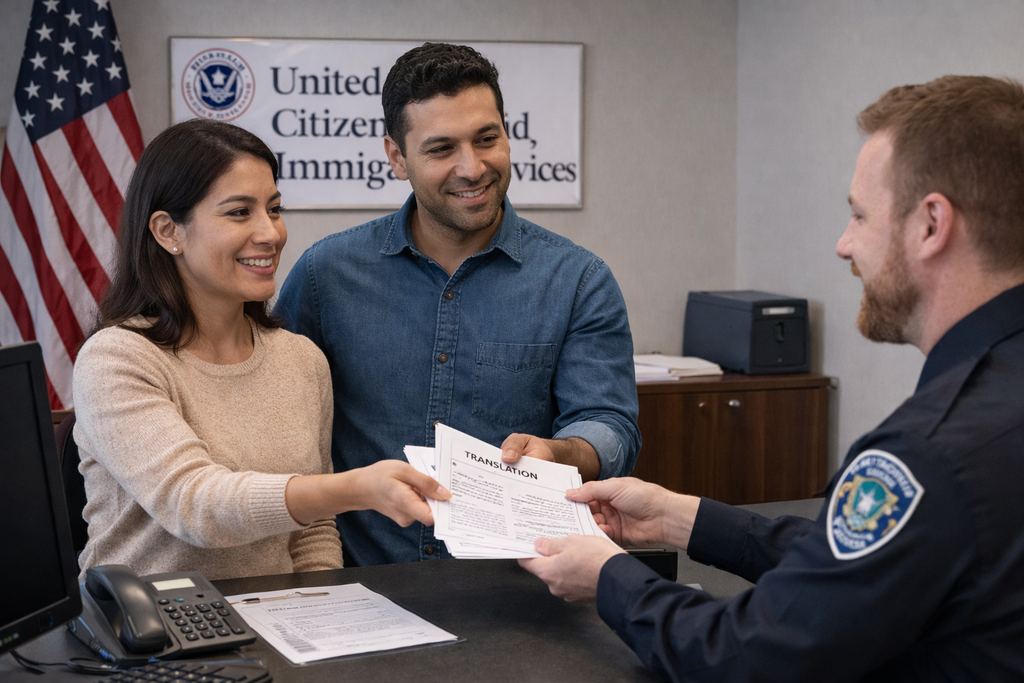
If you are applying for immigration benefits in the United States, you may need to submit documents written in another language. The U.S. Citizenship and Immigration Services (USCIS) requires that all foreign-language documents be accompanied by a complete English translation.
Many immigration applications are delayed or rejected simply because the translation does not meet USCIS requirements.
In this guide, we will walk you through exactly how to translate documents for USCIS correctly, so your application can be processed smoothly.
USCIS Translation Requirement
According to U.S. Citizenship and Immigration Services, any document submitted in a foreign language must include:
- A complete English translation
- A certification statement
- The translator’s name and signature
- A statement confirming the translator is competent to translate
This rule applies to almost all immigration applications.
Common Documents That Require Translation
Most immigration applicants need certified translations for documents such as:
- Birth certificates
- Marriage certificates
- Divorce decrees
- Passports
- Police records
- Academic transcripts
- Medical records
- Court documents
Even small details like stamps, seals, and handwritten notes must be translated.
Step-by-Step Guide to Translating USCIS Documents
Step 1: Scan or Photograph the Original Document
First, create a clear digital copy of your document.
Tips:
- Use high resolution
- Ensure all text is visible
- Avoid shadows or cut-off edges
Most translation agencies accept PDF, JPG, or PNG files.
Step 2: Translate the Entire Document
USCIS requires complete translation of every element on the document.
This includes:
- Printed text
- Handwritten notes
- Official stamps
- Seals
- Signatures (not translated but labeled)
Example:
Signature: [Signature]
Official Stamp: Ministry of Public Security
Nothing should be omitted.
Step 3: Format the Translation Properly
The translated document should follow a professional format.
Typical formatting includes:
- Header: Certified Translation
- Clear document layout matching the original
- Labels for stamps or seals
- Page numbering
Professional formatting helps USCIS officers review your documents quickly.
Step 4: Add a Certification Statement
USCIS requires a certification confirming the translation is accurate.
A standard certification statement looks like this:
Certification of Translation Accuracy
I certify that I am fluent in both English and the original language, and that the translation is complete and accurate to the best of my knowledge.
Translator Name
Signature
Date
Without this certification, USCIS may reject the document.
Step 5: Submit the Translation with Your Application
When submitting your immigration packet:
Attach the documents in this order:
- Original foreign-language document (copy)
- English translation
- Translator certification
Do not staple documents directly to immigration forms.
Can I Translate My Own Documents for USCIS?
Technically, USCIS allows any competent translator to complete the translation.
However, the translator cannot be the applicant.
For this reason, many applicants choose to use professional certified translation services.
This ensures:
- Accurate translation
- Proper certification
- Correct formatting
- Faster processing
Common Translation Mistakes That Cause USCIS Rejections
Many immigration applications are delayed because of translation errors.
Common problems include:
- Missing certification statement
- Partial translations
- Incorrect formatting
- Machine-only translations without review
- Missing translator signature
Even small mistakes can slow down your immigration case.
Tips to Avoid USCIS Translation Issues
To prevent delays:
- Always submit complete translations
- Use clear document scans
- Include certification statements
- Keep formatting professional
- Double check names, dates, and numbers
Accuracy is extremely important in immigration documents.
Need Help Translating Immigration Documents?
If you need certified translation for immigration documents, professional translation services can help ensure your documents meet USCIS requirements.
Clear Bridge Language Solutions LLC provides certified translations for immigration, legal, medical, and academic documents in more than 60 languages.
Clients can securely upload documents online and receive certified translations by email.
Learn more or upload documents securely at:
FAQ: USCIS Translation
Do USCIS translations need to be notarized?
No. USCIS generally does not require notarization, only a translator certification.
How long does translation take?
Many translation services offer same-day or 24-hour turnaround, depending on document length.
Can USCIS reject a translation?
Yes. If the translation is incomplete, missing certification, or inaccurate, USCIS may request corrections.
Final Thoughts
Submitting properly translated documents is a critical step in any immigration application.
By following the correct format and certification requirements, you can avoid unnecessary delays and ensure your documents meet USCIS standards.